Problem 1
I skipped a pile of cult cinema and want to see those films as general education. As a kid I fell asleep when they ran on the Tonis TV channel at night.
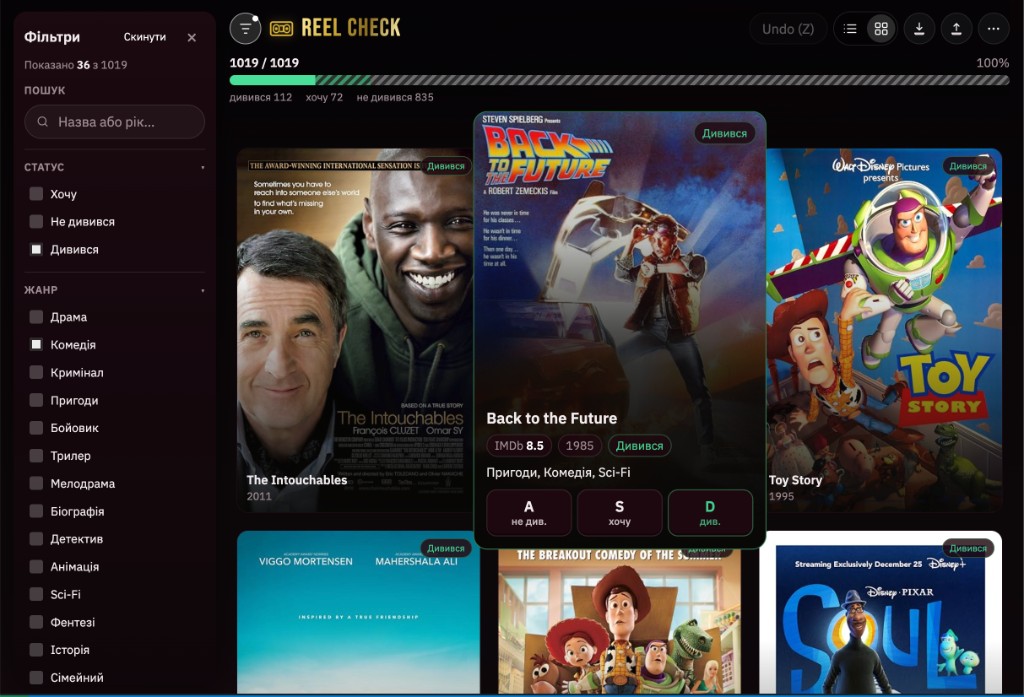
Reel Check is my personal tool for picking a Friday-night film.
I built it for myself, because I had skipped a lot of cult films. There are pictures it is a crime to miss. And sometimes the mood is “I want to watch something” — and I have no idea what.
I skipped a pile of cult cinema and want to see those films as general education. As a kid I fell asleep when they ran on the Tonis TV channel at night.
There is no place on the internet I actually want to open to pick a film. Sites are already ads at the choosing stage. Interfaces are description-centered, not movie-centered.
The world’s top 1000 films is a lot — and I will not watch all of them. I wanted to mark which ones are actually interesting to see.
Sharpen prototyping. General intellectual and vibe practice.
This is a product for myself, so I do not run every methodology I use on client SaaS. The goal is to prototype fast — and I do that fast.
When Friday night wants a film and streaming feels like work, hire a tool that gets me to one title I already wanted — in minutes.
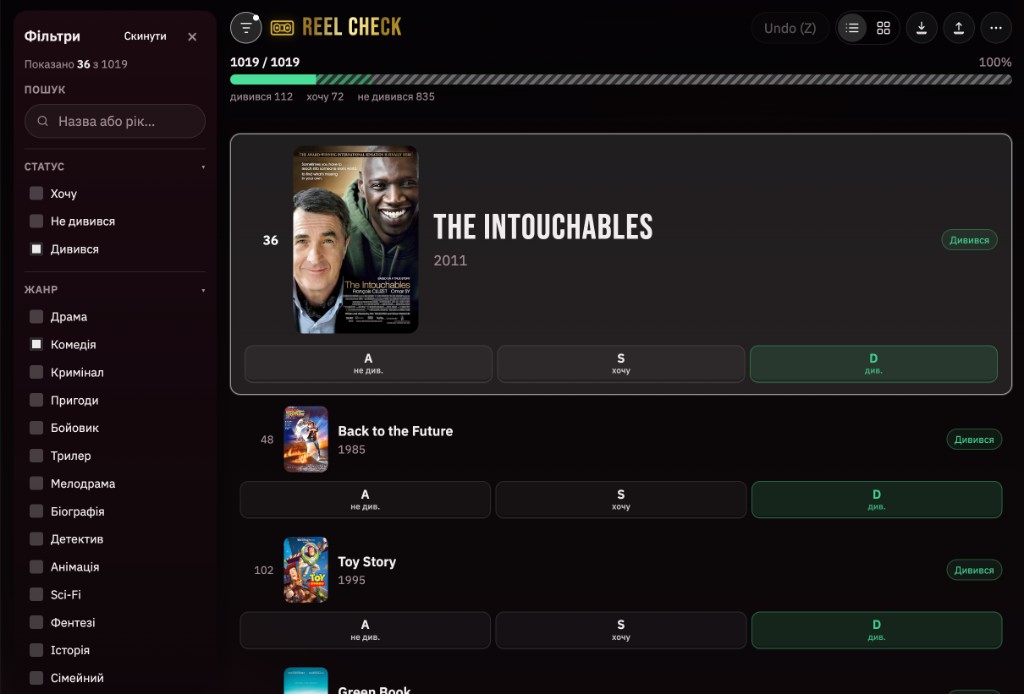
That is how the site saves time through micro-interactions. I marked all 1,000 films in half an hour — systematized everything I still wanted to catch up on from my teens.
So I got two modes in one interface: a fast pass when I need to sort a pile, and a pointed pick when it is already Friday and I need one title. Not a platform. Two actions I actually do.
I treated the UX as a product you actually use every evening: a dark cinema-like interface, a filter sidebar that stays out of the way when you do not need it, collapsible sections so you do not drown in options, a progress bar as a feedback loop — you can see how much is already sorted and how much is still ahead.
If this were a product, not an evening thing: SLC = 1,000 films + pick tonight.
Paid layer — connect two or more accounts to find shared films neither of you have seen, plus calendar integration to make inviting friends easy.
Price: one-time, not a subscription. It is a small product, and I would wrap it as “support the author” until the market says otherwise. If demand outran expectations, I would revisit. I did not think about this then — I was not building it for that.
I would not run ads and I would not touch cashback: the unit economics would not add up (irregular usage; Customer Acquisition Cost for a movie app is expensive against established competitors; unique value is half an hour of sorting — a one-off job).
“I skipped a cultural layer” is not in my top 100 problems, but I still wanted to practice — and to care about speed and ease of use. This is my personal local micro-app. It took two evenings. It will save hours of shorts in favor of cinema classics.
The value is not a catalogue of a thousand posters. The value is decision fatigue taken off: half an hour of triage instead of years of “I’ll watch it someday” — and on Friday, two clicks from Want to a specific film, not to shorts.
Build software you enjoy using yourself.